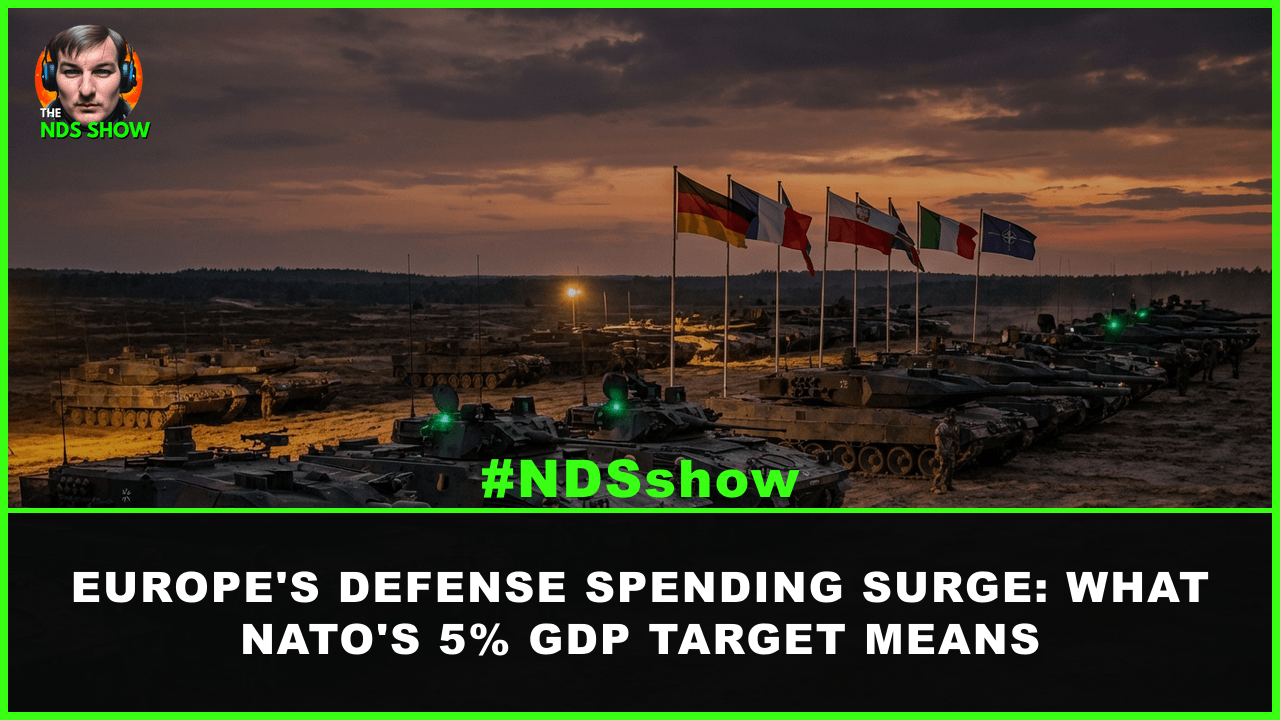
Europe’s Defense Spending Surge: What NATO’s 5% GDP Target Means for America
NATO allies pledged 5% GDP defense spending by 2035. With Germany past $107B, Europe’s rearmament reshapes the transatlantic defense industry landscape.
Something historic is happening across the Atlantic, and it’s going to reshape the defense world for the next decade. European nations aren’t just talking about boosting their militaries anymore. They’re actually doing it, and the numbers are staggering.
At the 2025 NATO summit in The Hague, all 32 member states (minus Spain) committed to spending 5% of their GDP on defense by 2035. That’s not a typo. Five percent. To put that in perspective, most European countries spent years struggling to hit the old 2% target. Now they’re aiming for more than double that.
🐦
Follow @ndsshow on X for real-time national defense and intelligence updates.
The Numbers Tell the Story
Germany has been the headline grabber here. In 2025, German defense spending crossed the $100 billion mark for the first time, reaching $107 billion. That’s up from $86 billion just a year earlier. The New York Times reported today that Germany’s military budget could soon exceed those of Britain and France combined, which is making some European capitals nervous.
But Germany isn’t alone. Poland has pushed its defense spending to 4.7% of GDP, making it one of NATO’s top spenders relative to its economy. The Netherlands committed to 3.5% of GDP on defense plus anoth
er 1.5% on defense-adjacent spending. Across the board, European NATO members averaged 2.16% of GDP on defense last year, according to the International Institute for Strategic Studies.
Europe now accounts for roughly 21% of global defense spending, and that share is climbing fast.
Why Now? Three Converging Forces
Three things are driving this shift simultaneously. First, Russia’s war in Ukraine has made the threat feel real in a way it hasn’t since the Cold War. Countries that border Russia or sit near the conflict zone aren’t debating whether to spend more. They’re debating how fast they can spend it.
Second, there’s growing uncertainty about America’s commitment to European security. NATO Secretary General Mark Rutte has been blunt about the reality: “Europe can defend itself without the US? Keep on dreaming. You can’t.” But that bluntness is exactly why European leaders are trying to reduce their dependence.
Third, the technology landscape is shifting. Ukraine has become a proving ground for new military tech, especially drones. The country manufactured between 2.5 and 4 million drones in 2025 and aims for 7 million in 2026. European defense startups are riding this wave, attracting venture capital that used to flow almost exclusively to Silicon Valley defense firms.
Here’s where it gets interesting for Americans watching the defense sector. U.S. defense firms currently account for nearly half of global sales, while European companies hold just under a quarter. Europe buys about half its defense goods from American companies, a proportion that’s actually grown over the past five years.
But that could change. The EU is rolling out policies that prioritize European suppliers. Concepts like “digital sovereignty” and “strategic autonomy” are moving from academic papers to actual procurement rules. McKinsey estimates that Europe’s dependence on U.S. cloud services (about 80% of spending) is a particular vulnerability European leaders want to address.
For companies like Lockheed Martin, RTX, and Northrop Grumman, Europe’s spending surge is a double-edged sword. More money flowing into defense means more potential contracts. But “buy European” policies could limit access to that growing market. The smart U.S. firms are already partnering with European companies and setting up local production. Those that don’t adapt may find themselves locked out.
The Bigger Picture
What we’re witnessing is the most significant restructuring of Western defense spending since the end of the Cold War. The old model, where America provided the bulk of NATO’s military capability and European allies contributed at the margin
s, is being replaced by something more balanced but also more complicated.
European defense companies like Rheinmetall, BAE Systems, and Leonardo are positioning themselves to capture this growth. Rheinmetall is building a €535 million gunpowder plant in Romania. Leonardo’s CEO has called for more collaboration across European defense firms to compete with American giants. Defense stocks across Europe have been on a tear.
For the United States, the strategic calculation is tricky. Washington has spent decades pushing allies to spend more on defense. Now that they’re actually doing it, the question becomes: will that spending strengthen the alliance, or will it create a competitor? The answer is probably both.
Key Takeaways
NATO’s 5% GDP target by 2035 represents a historic commitment, with Germany already past $107 billion in annual defense spending
Three forces are driving the surge: Russia’s war in Ukraine, uncertainty about U.S. commitment, and a shifting technology landscape favoring European startups
U.S. defense firms face a paradox: more money in the market, but growing “buy European” policies could limit American access
The transatlantic defense relationship is being rewritten in real time, with implications for procurement, technology sharing, and alliance cohesion
Watch the Full Episode
For a deeper dive into how the shifting defense landscape affects U.S. strategy, check out this episode of The NDS Show:
🎙️ Don’t Miss an Episode of The NDS Show
Stay informed on national defense, intelligence, and geospatial topics. Subscribe to The NDS Show on YouTube for in-depth interviews and analysis.